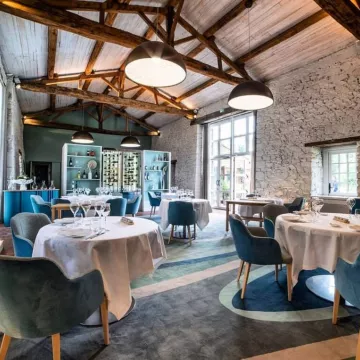
Vendean know-how and products at the heart of La Chabotterie gourmet restaurant
Meilleur ouvrier de France 2015, Benjamin Patissier took over the helm of La Chabotterie restaurant with his wife Audrey in July 2021. Convinced by the environmental approach of short circuits and keen to showcase regional know-how, they call on Vendée artisans as often as possible. Interview with Benjamin Patissier, new Michelin-starred chef in 2022.
You're originally from the Nantes region. What motivated you to move to the Vendée? Why La Chabotterie?
My wife and I had been working in the Rhône Valley for around ten years. We wanted to set up a personal project by opening a restaurant in our own image, close to nature and the terroir. And then came the confinement. With the restaurant business at a standstill, we matured our project and took the plunge: we moved back to our home region to be closer to our families and create a gastronomic establishment that reflected our own personality.
Our friends and family had told us about an invitation to tender to take over La Chabotterie restaurant. The historic site, the peaceful green setting, the potential... everything matched our aspirations. We surrounded ourselves as best we could to put together our dossier, and we won the tender. In July 2021, we opened restaurant La Chabotterie.
During your formative years and at the start of your career, what else did the chefs you worked with pass on to you, beyond technical gestures?
Through their technique and personality, each chef gave me something different. From all these encounters, I drew what I considered to be the best of each of them, and I apply it today. For example, I worked with Pierre Gagnaire, who was very paternalistic but also very creative. I worked with Patrick Henriroux, who was a talented entrepreneur who taught me how to be a good manager, but also how to look at the restaurant as a whole. I also worked with Christian Née, chef de cuisine and great technician. I tried to draw inspiration from him, with a humble and simple approach to cooking. Every day, with the brigade, when we make preparations, I ask myself how each of these chefs would have done it, and so on.
How would you define the cuisine you offer today?
With my cooking, I just want people to have a good time in the restaurant, to recognize the products and appreciate their taste. I want to give them the opportunity to eat something they wouldn't eat at home without the association of flavors from elsewhere. The idea is to raise questions about product combinations. Quality and taste are the DNA of the dishes I want to offer, based on regional products.
When we set up the brigade, we were careful to recruit people who respected both the products and their colleagues. Rigor, kindness, proximity and simplicity are essential qualities for working together with products from Vendée and the surrounding area.
You advocate strong roots in the local landscape. What role do local products play in your cuisine?
Because we're based in the Vendée region, we're fortunate to have the sea nearby, market garden produce just a few kilometers away, and cattle and goat farms in the area. We're also fortunate to have a 42-hectare park with herbs and flowers that enhance our preparations. Raising awareness of nature among every member of the team is part of what we want to pass on.
We have everything we need to offer a varied cuisine, not necessarily fixed on one type of product, as can be the case on the seaside with a menu featuring 100% fish, for example. Here, you can do a bit of everything!
How do you choose your suppliers and producers?
We try to choose our suppliers close to home, for logistical reasons, but also to be consistent with what we preach on a daily basis. Human relations are also very important. It's important to us to be able to exchange easily and locally with producers, rather than with an anonymous logistics platform far away from us.
We select producers by word-of-mouth, following meetings. For ewe's milk cheeses, for example, we've made various contacts and tested samples. We taste and imagine how to enhance the product according to its shape, texture, taste, color... Our kitchen is always on the move!
I'm always on the lookout for quality products to incorporate into my dishes. In particular, I like to cook with citrus fruits and wild mushrooms, but I haven't yet found any producers in the Vendée.
The main constraint at the moment is logistics: the question is how they can deliver to us, often in small volumes, at a time of rising fuel prices.
Do you have a product that you particularly enjoy working with?
In the kitchen, you can do everything. When we work with a vegetable or a fish, we don't approach it in the same way. We respect each product for what it is. I try to create menus with a common thread, a coherence: don't have only juices on every dish, look for an alternation of flavors.
I'm not interested in cooking a product because it's "trendy". I prefer seasonal, local, quality produce. To cook, I wait until it's the right time for the product. I discuss this with my partner producers. For example, last year, I was able to cook raspberries until the end of September, thanks to a small local producer who had raspberry bushes that produced fruit late in the season.
Can you tell us about some of the Vendée producers you work with on a regular basis?
It's the products and their seasonality that guide us in our purchasing and menu development. With avian flu, the foie gras production chain is in trouble. As a result, we are withdrawing it from the menu for spring 2022. On the other hand, we have a producer who raises trout in aquaponics, which gives us the opportunity to showcase this fish.
For cheeses, as for vegetables, fruit or farmed products, it's the life cycle that sets the pace for our choices. Squid are more likely to be available in autumn, while berries arrive with the warm weather in spring.
As far as producers are concerned, I can mention the exceptional quality of rapeseed and sunflower oil from Ferme d'Ursule (Chantonnay). Or fish from the Criée des Sables d'Olonne, fresh ewe's milk cheese from Ferme Gustin, snails from Maison Royer, etc.
You've also chosen local artisans for your tableware, decorations and the Chabotterie park. Can you tell us about these collaborations?
In the same spirit as for the kitchen, we wanted the restaurant at La Chabotterie to be an expression of local know-how. My wife and I chose a decorator and carpenter from La Roche-sur-Yon. All our displays were created by a cabinetmaker from Nesmy. We also called on a ceramist from Mouchamps and a landscaper from Belleville. We also have porcelain centerpieces made from oyster shells by a company based in Poiré-sur-Vie, and knives fashioned by a cutlery blacksmith in La Gaubretière. From the kitchen to the dining room, we're determined to keep our focus on local know-how.
Interview by Sandrine Damie - May 2022.